Methodological Analysis of the 2026 Formula 1 Calendar Restructuring and Logistical Sustainability
The 2026 Formula 1 Calendar represents a definitive shift in the operational philosophy of global motorsport, prioritizing geographical grouping to achieve significant reductions in carbon emissions. As the sport transitions to 100% sustainable fuels and radically revised technical regulations, the 2026 Formula 1 Calendar serves as the structural foundation for this “New Era.” For digital data platforms and venue display operators, the synchronization of a 24-race schedule spanning five continents requires unprecedented accuracy. This report examines the 2026 Formula 1 Calendar through the lens of logistical efficiency, highlighting the debut of the Madrid Grand Prix and the strategic relocation of long-standing events.
A primary objective of the 2026 Formula 1 Calendar is the minimization of “leapfrog” travel, where teams historically traversed oceans multiple times in a single quarter. In the 2026 iteration, the Canadian Grand Prix has been strategically moved to May, immediately following the Miami Grand Prix. This consolidation creates a singular North American stint, allowing for “freight clustering” that significantly reduces the environmental impact of transatlantic logistics. Such precision in the 2026 Formula 1 Calendar is vital for team principals who must manage the “Triple-Header” fatigue that often compromises engineering performance during the season’s final stages.
Structural Evolution: The Debut of the Madrid Grand Prix and European Consolidation
The 2026 Formula 1 Calendar marks a historic return to the Spanish capital with the inauguration of the Madrid Grand Prix. Located in the Barajas district, this semi-permanent hybrid circuit represents the future of urban racing logistics, featuring state-of-the-art multimodal transport links. Within the 2026 Formula 1 Calendar, Madrid serves as the conclusion to the European leg, paired as a double-header with Monza. This restructuring led to the omission of the Emilia-Romagna Grand Prix at Imola, reflecting a broader trend toward high-capacity, technologically advanced venues that can support the sport’s expanding digital infrastructure.
For data analysts, the 2026 Formula 1 Calendar introduces a new cadence to the championship battle. The season officially commences on March 8 in Melbourne, returning the Australian Grand Prix to its traditional opening slot. The following factors define the competitive rhythm of the 2026 Formula 1 Calendar:
- The inclusion of six Sprint events at venues optimized for wheel-to-wheel racing, including China and Miami.
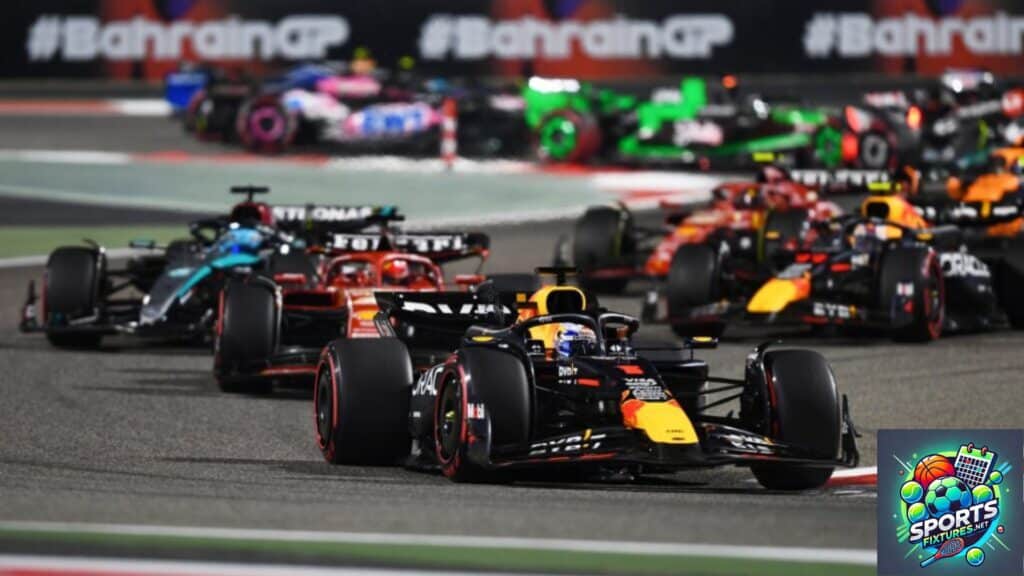
- A consolidated Middle Eastern double-header in Bahrain and Saudi Arabia during the April window.
- The implementation of three distinct pre-season testing blocks to accommodate the 2026 power unit transition.
- The concluding “Asian-American-Middle Eastern” sequence, featuring the final triple-header in Las Vegas, Qatar, and Abu Dhabi.
Technological Oversight of Active Aerodynamics and Energy Deployment
The 2026 Formula 1 Calendar coincides with the most significant technical overhaul in a decade, featuring cars that are 30kg lighter and utilize “Active Aerodynamics.” As the cars alternate between “X-mode” for straights and “Z-mode” for corners, the real-time data feeds displayed at venues must provide instantaneous telemetry updates to the audience. The 2026 Formula 1 Calendar is the canvas upon which these new “Manual Override” modes will be tested. For information platforms like SportsFixtures.net, the integration of these technical variables alongside the 2026 Formula 1 Calendar is essential for providing a comprehensive analytical experience.
Furthermore, the 2026 Formula 1 Calendar has been designed to account for the increased electrical dependency of the new power units. Circuits with high kinetic energy recovery potential have been prioritized to showcase the nearly 300% increase in MGU-K output. As teams navigate the 2026 Formula 1 Calendar, the “Energy Management Strategy” will become as critical as tire wear. The schedule’s layout, featuring high-speed circuits followed by technical street tracks, will expose the strengths and weaknesses of different ERS (Energy Recovery System) configurations, ensuring that the 2026 Formula 1 Calendar remains a true test of engineering versatility.
Forecasting the Economic and Environmental Impact of the 2026 Schedule
The 2026 Formula 1 Calendar is a cornerstone of the sport’s commitment to becoming Net Zero Carbon by 2030. By reducing total freight travel distance by an estimated 15%, the calendar sets a precedent for other global touring series. Strategic forecasting indicates that the 2026 Formula 1 Calendar will generate record-breaking engagement due to the entry of new manufacturers like Audi and the Ford-Red Bull partnership. The stability of the 2026 Formula 1 Calendar—achieved through multi-year venue contracts—allows for the long-term planning of sustainable “Green Zones” at every Grand Prix location.
In conclusion, the 2026 Formula 1 Calendar is a sophisticated logistical framework that balances global expansion with environmental responsibility. It provides the necessary structure for a new generation of more agile, sustainable racing machines. For stakeholders who rely on precise, real-time fixture data, the 2026 Formula 1 Calendar is the most vital document in the pursuit of operational excellence. As we track the progress from Melbourne to Abu Dhabi, the focus remains on the precision of the schedule and the integrity of the data that defines the pinnacle of motorsport. The 2026 Formula 1 Calendar is not just a list of races; it is the blueprint for a sustainable future.
- Analysis of the “Triple-Header” physical toll on pit-crew efficiency.
- Relationship between circuit latitude and sustainable fuel thermal performance.
- Impact of Saturday night racing in Las Vegas and Baku on global broadcast viewership metrics.
As the 2026 season approaches, maintaining a rigorous focus on the 2026 Formula 1 Calendar updates is essential for any high-level sports analysis. The ability to synchronize technical regulation shifts with a 24-race itinerary is a testament to the sport’s administrative evolution. For the digital ecosystem of sports fixtures, the 2026 Formula 1 Calendar remains the ultimate benchmark for data-driven logistical management. We look forward to a season that pushes the boundaries of both human and technological performance within a perfectly optimized schedule.